Services
All Services New Product Development SaaS Development Legacy Modernization AI / ML Integration LLM Agents Data Analytics and Dashboards DevOps and Cloud AI Search Optimization VoIP Development Prescr (Healthcare Product)
Industries
Healthcare Fintech SaaS Insurance Telecom and VoIP
Hire and Pricing
Hire Developers Pricing
Resources
Blog AI News Case Studies Free Tools Free Downloads FAQ
Company
About Us Partner Program Our Process Careers Contact Book a Consultation
SEO · AEO · GEO · AI search

AI search optimization: get ranked on Google and cited by AI answers

AI search optimization is the work of making your website the source that Google ranks, answer engines quote, and AI assistants such as ChatGPT, Perplexity, Gemini and Claude cite. We run it as a monthly program that combines SEO (ranking), AEO (being the direct answer) and GEO (being cited in AI answers), from $1,600 to $10,000 a month.

RG INSYS LLP runs AI search optimization programs for companies in the US, UK, UAE, Australia and Canada. Senior engineers work on the three layers AI search depends on: a crawlable, fast, well structured site (SEO), pages that answer real questions directly (AEO), and content and facts that AI assistants trust enough to cite (GEO).

What we deliver
Technical SEO and AI crawler audit, PageSpeed fixes, structured data, FAQ and answer-first content from real search questions, consistent entity facts, and monthly AI visibility tracking.
Where you show up
Google Search and AI Overviews, Bing and Copilot, ChatGPT search, Perplexity, Gemini and Claude.
Pricing
$1,600 to $10,000 per month, set by site size, markets and how much content and engineering you want each month. Free written audit first.
First 30 days
Baseline scorecard, Lighthouse on mobile and desktop, an AI prompt baseline and the first round of technical fixes.
Reporting
A monthly scorecard: SEO, AEO and GEO scores, PageSpeed, Search Console data, AI referrals and tracked AI prompts.

What is the difference between SEO, AEO and GEO?

They are three layers of the same job. SEO gets a page ranked. AEO gets it chosen as the direct answer. GEO gets it cited inside AI-generated answers. Google treats its AI features as part of Search, and other assistants retrieve from search indexes, so the layers stack: a page that is not crawled and indexed cannot be quoted by any of them.
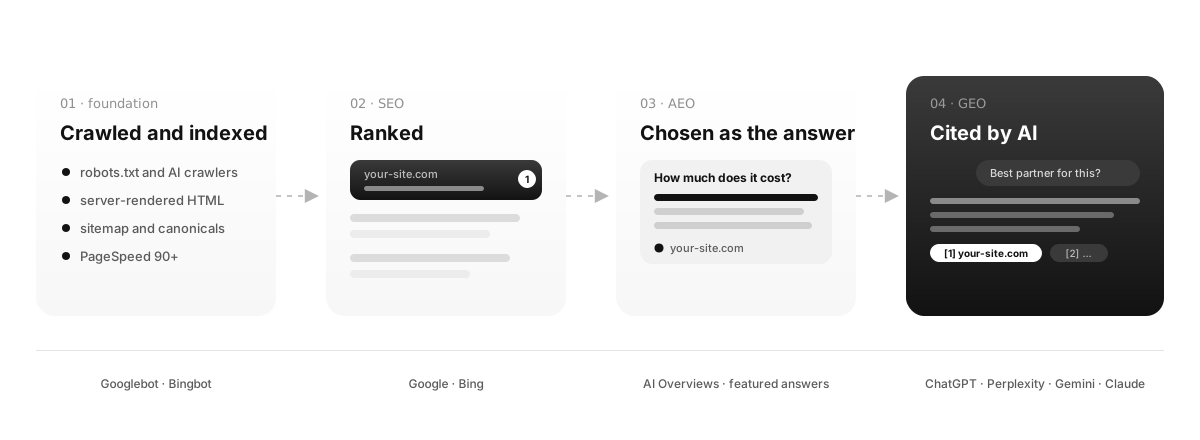
Four stages of AI search: crawled and indexed, ranked on Google and Bing (SEO), chosen as the answer in AI Overviews (AEO), and cited by ChatGPT, Perplexity, Gemini and Claude (GEO)
LayerGoalWhere it showsWhat moves it
SEORank in search resultsGoogle and Bing resultsCrawlability, speed, relevance, internal links, reputation
AEOBe the direct answerFeatured snippets, AI Overviews, voice answersQuestion headings, 40 to 60 word answers, FAQs, lists and tables
GEOBe cited by AIChatGPT, Perplexity, Gemini, Claude, Google AI ModeOriginal data, cited sources, named experts, consistent facts
What's included

What does an AI search optimization program include?

Technical and AI crawler foundation

Robots rules that let search and answer bots in (Googlebot, Bingbot, OAI-SearchBot, Claude-SearchBot, PerplexityBot), server-rendered content, canonicals, sitemaps and a clean index. Whether AI training crawlers get access stays your decision.

PageSpeed and Core Web Vitals

Lighthouse on mobile and desktop every month, against clear targets: Performance 90+, and Accessibility, Best Practices and SEO 95+. Fixes go into your code, not behind a plugin.

Question research and answer-first pages

We collect the questions people type into Google, Bing and DuckDuckGo and the follow-ups AI assistants fan out to, then add direct answers, question headings and FAQs to the pages that should own them.

Structured data and consistent facts

Organization, Service, Article, Breadcrumb and FAQ markup that mirrors the visible page, and one consistent set of facts (names, prices, locations) across your site, your profiles and llms.txt.

Content worth citing

Original data, case studies, named authors with credentials, visible dates and links to primary sources: the signals AI answers lean on when they choose whom to cite.

AI visibility tracking

Monthly checks of a fixed set of buyer prompts in ChatGPT, Perplexity, Gemini and Google AI Overviews, plus the generative AI report in Search Console and AI referral traffic in your analytics.

Our method

How does a monthly program work?

01
Audit and baseline, weeks 1 to 2

A full SEO, AEO and GEO scorecard, Lighthouse on mobile and desktop, an AI prompt baseline and a prioritised fix list, with every item tagged: we fix it, we draft it, or we need your input.

02
Foundation fixes, weeks 2 to 4

Crawlability, metadata, structured data, page speed and accessibility fixes, shipped on a branch, built and re-measured before anything goes live.

03
Answers and authority, ongoing

New answer-first sections, FAQ questions from real searches, author and source upgrades, and entity cleanup, page by page, in your voice.

04
Measure and report, monthly

The scorecard and Lighthouse re-run the same way each month, AI prompt tracking, and a written report of what moved, what did not and what comes next.

What we won't do

Search engines and AI assistants reward pages people can trust, and penalise shortcuts. These are the lines we do not cross on your site:

  • Promise rankings or AI citations. Nobody controls them. We control the inputs and measure them honestly.
  • Mass-produce near-duplicate or spun pages. Google treats scaled content abuse, doorway pages and attempts to manipulate AI answers as spam.
  • Hide text, stuff keywords or buy links and mentions. Every title, answer and link is written for the person reading it.
  • Sell llms.txt or “AI schema” as a shortcut. Google Search does not use llms.txt, and there is no special markup for AI features.
  • Invent reviews, statistics or credentials. Anything we cannot verify comes back to you as a question.
Proof

We run the same program on our own site

rginsys.com · October 2026 Our own audit, lab measurements

48 pages with FAQs but no FAQ markup, and a homepage held back by its 3D scene

Our audit of rginsys.com found 48 pages whose visible FAQs had no FAQPage markup, no main landmark on any page, blog dates that machines could not read, and a homepage slowed by its WebGL animation. We fixed what could be fixed in code, checked every FAQ answer in the markup against the page, re-measured with Lighthouse, and turned the rest into a list of decisions for our own team.

48Pages given FAQ markup
322FAQ answers verified
62 → 81Desktop home score (lab)
100Lighthouse SEO score
Pricing

How much does AI search optimization cost?

$1,600 to $10,000 per month

One monthly price, agreed in writing after a free audit. Where you land depends on the size of your site, the number of markets and languages, and how much content and engineering you want shipped each month.

  • Smaller sites in one market start at $1,600 a month
  • Large, multi-market or multi-language programs run up to $10,000 a month
  • Every program includes the scorecard, Lighthouse tracking and a monthly report
  • Monthly retainers cancel on 30 days notice
Get your free audit

Free written audit and fixed monthly quote within 48 hours.

FAQ

Common questions about AI search optimization

SEO gets your page ranked in search results, AEO gets it chosen as the direct answer in featured snippets, AI Overviews and voice results, and GEO gets it cited inside answers from ChatGPT, Perplexity, Gemini and Claude. They build on each other, so we work on all three together.
GEO is the practice of making your content the source AI assistants cite when they answer a question. It rests on normal SEO, because AI search retrieves pages from search indexes, plus original data, clear sourcing, named experts and consistent facts that make a page safe to quote.
AEO structures a page so an answer engine can lift a complete answer from it: a question as the heading, a direct 40 to 60 word answer underneath, then lists, steps or tables for the detail. FAQ sections built from real search questions are part of it.
No. Google says its AI features run on the same core ranking systems as Search, and other AI assistants retrieve from search indexes too. SEO is the foundation; AEO and GEO are what you build on top of it.
Each month we re-run the same scorecard and Lighthouse tests, check a fixed list of buyer prompts in ChatGPT, Perplexity, Gemini and Google AI Overviews to see whether you are cited and described accurately, and report Search Console data and AI referral traffic from your analytics.
Technical fixes and PageSpeed gains show up in tests as soon as they ship. Search engines then need weeks to recrawl, and rankings and AI citations usually build over several months. We report progress monthly so you can see which changes moved the numbers.
No, and be wary of anyone who does. No agency controls Google's rankings or what an AI model cites. We control the inputs: a technically sound site, direct answers to real questions, and content worth citing, measured the same way every month.
Our programs run from $1,600 to $10,000 per month. The price depends on the size of your site, how many markets and languages you target, and how much content and engineering work you want each month. You get a free written audit and a fixed monthly quote first.
Not for Google: Google Search does not use llms.txt. Some other AI tools read it, so we keep yours accurate if you have one, but it is never a substitute for crawlable, well structured pages.
Technical SEO is a fixed price engineering project for speed, rendering and crawlability. AI search optimization is an ongoing monthly program that includes that technical work and adds question research, answer-first content, structured data, authority signals and AI visibility tracking.
Free audit, no commitment

Want to be the answer?

Get a free AI search audit: a written scorecard for SEO, AEO and GEO, and a fixed monthly quote within 48 hours.

Book Consultation