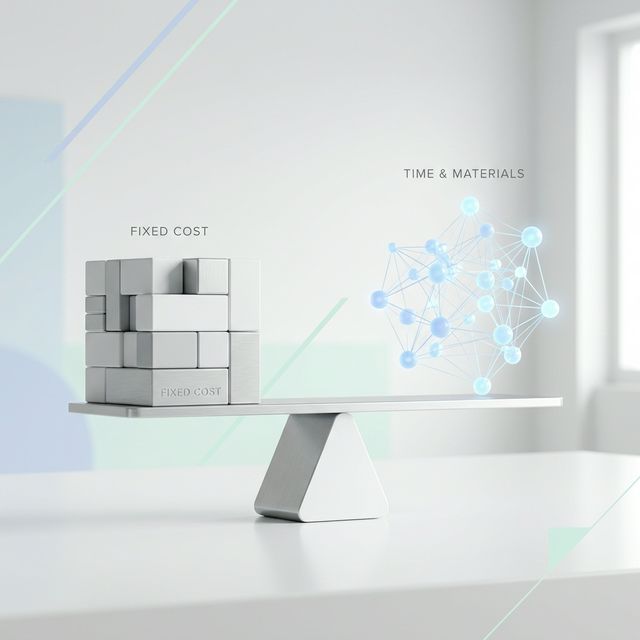
Choosing between a fixed price contract and a time and materials arrangement is one of the first and most consequential decisions you will make when outsourcing software development. Pick the wrong model and you end up either overpaying for a rigid scope or losing control of a budget that keeps climbing. Pick the right one and the entire engagement runs smoother, from kickoff to launch.
At RG INSYS, we offer both models and frequently help clients decide which one fits their situation. This article breaks down how each model works, when each shines, and how to make a confident decision for your next project.
What Fixed Price Actually Means
In a fixed price engagement, the scope, timeline, and total cost are agreed upon before development begins. The client pays a predetermined amount, and the development partner delivers the defined set of features within the agreed schedule. If the work takes longer than expected, the vendor absorbs that cost. If it finishes early, the vendor benefits.
This model works like hiring a contractor to build a house from an approved blueprint. Every room, fixture, and finish is specified upfront. Any change to the plan triggers a formal change order with a revised price.
Fixed price contracts are appealing because they offer budget certainty. You know exactly what you will spend before the first line of code is written. For organizations that need to secure internal approvals or allocate a finite budget, this predictability is extremely valuable.
What Time and Materials Actually Means
In a time and materials (T&M) arrangement, you pay for the actual hours worked and any direct expenses incurred. The scope is intentionally flexible. Requirements can evolve, priorities can shift, and new features can be added or removed without renegotiating the entire contract.
Think of it as hiring a skilled team on a monthly retainer. You direct the work, review progress at regular intervals, and adjust course as you learn more about what your users actually need. You pay for what gets built, nothing more and nothing less.
T&M is popular with teams that practice agile development because it accommodates the iterative, discovery driven nature of building modern software products.
When Fixed Price Works Best
Fixed price is the right choice when certain conditions are met:
- Requirements are crystal clear. You have detailed specifications, wireframes, and acceptance criteria documented before development starts. There is little ambiguity about what "done" looks like.
- The scope is well bounded. The project has a defined beginning and end, such as a migration, a compliance module, or a standalone internal tool.
- Regulatory or procurement constraints exist. Many government agencies, large enterprises, and regulated industries require fixed bids for vendor contracts.
- You need budget approval upfront. When stakeholders need a single number to approve, fixed price removes the uncertainty that can stall procurement.
The trade off is flexibility. Once a fixed price scope is locked, every change request introduces friction: new estimates, revised timelines, and additional costs. If your requirements are likely to evolve, this friction can slow you down significantly.
When Time and Materials Works Best
T&M is the stronger choice in these scenarios:
- Requirements are evolving. You have a vision but not a complete specification. Discovery, user research, and iterative feedback will shape the final product.
- The product is long lived. Ongoing applications that need continuous feature development, maintenance, and optimization benefit from the flexibility of T&M.
- Speed to market matters. T&M lets you start building immediately rather than spending weeks on detailed upfront specification.
- Innovation is the goal. When building something new, such as an AI powered feature or a product entering an unproven market, you need the freedom to pivot based on what you learn.
The trade off here is budget predictability. Without a fixed ceiling, costs can grow if priorities shift frequently or if scope expands beyond the original intent. Strong project governance and regular sprint reviews mitigate this risk.
Risk Allocation: Who Bears the Uncertainty?
Every software project carries risk: technical unknowns, shifting requirements, integration challenges, and timeline pressure. The engagement model determines how that risk is distributed.
In fixed price, the vendor assumes most of the delivery risk. If a feature takes three times longer than estimated, the vendor pays for those extra hours. To compensate, vendors typically build a risk buffer into their fixed price quote, often 15% to 30% above their base estimate. You are paying for certainty, and certainty has a premium.
In T&M, the client assumes the budget risk. If requirements expand or technical complications arise, the hours (and cost) increase. However, the client also retains full control over priorities and can stop, pause, or redirect at any time. You are paying for flexibility, and flexibility requires active oversight.
Neither model eliminates risk. Fixed price transfers it to the vendor. Time and materials keeps it with the client. The best choice depends on which side is better equipped to manage that uncertainty.
The Hybrid Approach: Best of Both Worlds
Many of the most successful engagements we run at RG INSYS use a hybrid model. The concept is straightforward: use fixed price for phases where the scope is clear, and T&M for phases where flexibility is essential.
A common structure looks like this:
- Discovery and planning phase (T&M): Spend two to four weeks defining requirements, creating wireframes, and producing a technical architecture. Pay for actual hours spent.
- Core development phase (fixed price): Once the scope is locked after discovery, execute the build at a fixed cost with defined milestones and deliverables.
- Post launch iteration (T&M): After launch, shift to T&M for ongoing improvements, bug fixes, and new feature development driven by real user feedback.
This approach gives you the budget certainty of fixed price where it matters most while preserving the agility of T&M during the phases that benefit from exploration.
Common Mistakes When Choosing a Model
We see several recurring mistakes from clients across industries:
- Choosing fixed price with vague requirements. This leads to endless change requests, disputes over what was "in scope," and a product that satisfies the contract but not the business need.
- Choosing T&M without governance. Without regular reviews, clear sprint goals, and transparent time tracking, T&M budgets can spiral. The flexibility of T&M requires discipline to use well.
- Comparing quotes across models. A fixed price quote and a T&M estimate are not directly comparable. The fixed price includes a risk buffer; the T&M estimate does not. Comparing them at face value is misleading.
- Ignoring the relationship factor. Fixed price can create an adversarial dynamic where the vendor wants to minimize scope and the client wants to maximize it. T&M, when done well, fosters a collaborative partnership. Consider what kind of relationship you want with your development team.
How AI Accelerated Development Changes the Equation
AI powered development tools have materially changed the calculus for both engagement models. At RG INSYS, our AI first workflow means we deliver production code significantly faster than traditional development cycles. This has two important implications:
For fixed price: Faster delivery reduces the vendor's risk, which means we can offer tighter fixed price quotes with smaller risk buffers. Projects that would have taken six months now take three, and the cost savings are passed to the client.
For T&M: Higher productivity per hour means clients get more value for every hour billed. A sprint that used to produce five screens now produces eight. The total cost of a T&M engagement drops because fewer hours are needed to achieve the same outcome.
In both models, AI accelerated development tilts the economics in the client's favor. The key is working with a partner who has genuinely integrated AI into their workflow rather than one that merely mentions it in marketing materials.
How RG INSYS Structures Engagements
We offer all three options: pure fixed price, pure T&M, and hybrid. Our recommendation depends on your situation, and we will always explain the reasoning behind it.
Every engagement starts with a free scoping consultation. For fixed price projects, we produce a detailed scope document with milestones and deliverables before quoting. For T&M projects, we agree on team composition, sprint cadence, and communication protocols. For hybrid engagements, we map out which phases are fixed and which are flexible.
Regardless of the model, every client gets weekly progress reports, access to a shared project board, and direct communication with the engineering team. Transparency is not negotiable in any model.
Decision Checklist
Use this checklist to guide your choice:
- Can you write a complete specification today? If yes, fixed price is a strong option. If not, lean toward T&M or a hybrid with a discovery phase.
- Is your budget capped with no room for variance? Fixed price gives you a hard ceiling. T&M requires a buffer for uncertainty.
- Will requirements change as you learn from users? T&M accommodates change naturally. Fixed price resists it.
- Is this a one time project or an ongoing product? One time builds suit fixed price. Ongoing products suit T&M.
- Do you have the capacity to manage the engagement actively? T&M requires regular reviews and prioritization from your side. Fixed price requires less day to day involvement.
- Is the technology proven or experimental? Proven stacks with known effort estimates suit fixed price. New or experimental technology introduces unknowns better handled by T&M.
There is no universally correct answer. The right model is the one that aligns with your project's maturity, your organization's tolerance for uncertainty, and the kind of partnership you want to build with your development team. If you are still unsure, start a conversation with us. We will help you figure it out.
Related Articles
- Offshore Development in 2026: What's Changed and What Still Matters
- AI Led vs Traditional Software Development: What Actually Changes
- What to Consider Before Modernising a Legacy System
Not sure which engagement model fits your project?
Get a free scope, timeline, and cost estimate within 48 hours. No commitment required.
Book a Free Consultation →